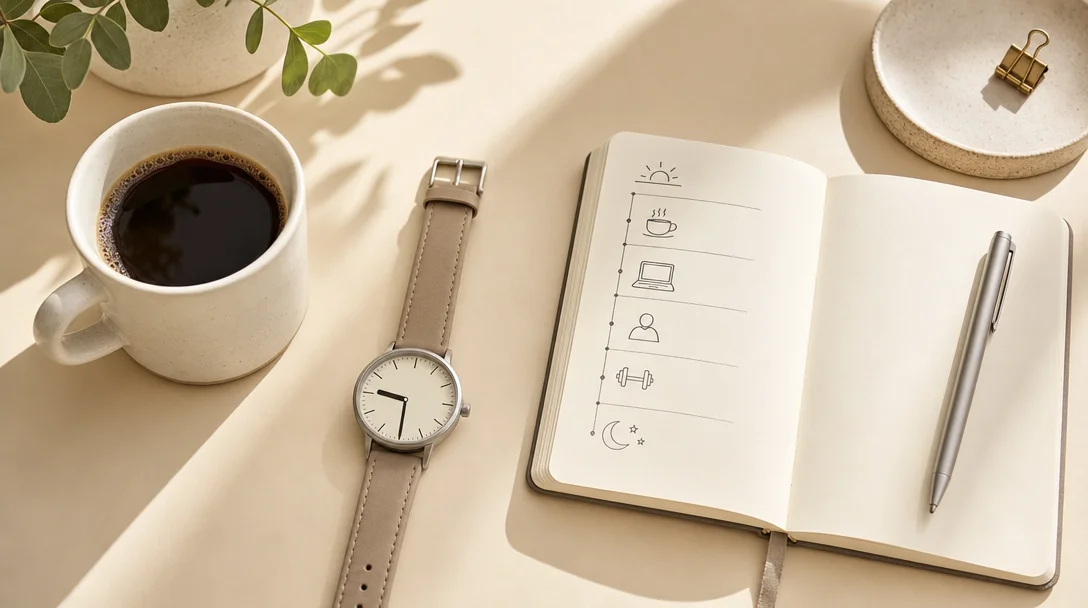
The caffeine timing protocol: how to get the energy without the crash
Most professionals drink caffeine at exactly the wrong times — immediately on waking (when cortisol is already high) and too late in the afternoon (sabotaging sleep quality). This guide covers the 90-minute delay rule, the strategic afternoon window, correct dosing, and a crash decoder to diagnose what's actually happening at 3pm.

☕ The caffeine timing protocol: how to get the energy without the crash
You already know caffeine works. What most professionals don't know is when it works — and when it quietly sabotages everything.
If you're reaching for coffee the moment you wake up, hitting a second cup right after lunch, and then wondering why you still crash at 3pm and can't fall asleep until midnight, you're not drinking too much caffeine. You're drinking it at the wrong times.
Here's the protocol that changes the math.
🧠 Why caffeine timing matters more than caffeine quantity
Caffeine works by blocking adenosine receptors in your brain. Adenosine is the molecule your brain produces as a byproduct of being awake — the longer you're up, the more it accumulates, and the more tired you feel. Caffeine doesn't reduce adenosine; it just sits in the receptor seats so adenosine can't deliver its "you're tired" message. 1
Here's the catch: the adenosine is still piling up. When the caffeine eventually wears off, the receptors open back up — and all that backed-up adenosine floods in at once. That's not an energy crash. That's an adenosine flood. The solution isn't more coffee. It's smarter timing.
There's a second problem most people don't know about. Caffeine has a quarter-life of roughly 12 hours in most people's bodies. That means if you drink a cup of coffee at noon, about 25% of that caffeine is still active in your system at midnight. Even if you fall asleep fine, that residual caffeine measurably reduces deep sleep quality — and poor deep sleep is exactly what leaves you dragging the next morning, reaching for more coffee. 2
One late afternoon coffee can quietly set off a week-long fatigue spiral.
⏰ The three-window caffeine protocol
Most professionals benefit from treating caffeine like a scheduled tool rather than a background comfort habit. Three windows control everything.
Window 1: the 90-minute delay rule
Your body produces a natural cortisol surge within the first 30–60 minutes after waking — called the cortisol awakening response. Cortisol is your body's own alertness hormone. When you drink coffee during that natural cortisol peak, you're largely wasting the stimulant effects. You're also training your body to rely on caffeine for what it was already doing on its own. 3
Dr. Andrew Huberman, a neuroscientist at Stanford, recommends delaying your first caffeine intake by 90 to 120 minutes after waking if you want to reduce afternoon crashes. The logic: let your natural cortisol wave do its job first, then layer caffeine on top as cortisol starts to decline. 2
In practical terms: if you wake up at 7am, your coffee window opens around 8:30–9am. Spend the first 90 minutes on water, movement, sunlight, or your most focused morning work. Your brain is more naturally primed for it than you'd expect.
Window 2: the strategic afternoon cup
The conventional wisdom is "don't drink coffee after noon." That's close — but the actual number is more flexible and more important.
Caffeine's alerting effects peak roughly 30 minutes after consumption and last about 60 minutes. 2 For most professionals dealing with a genuine 2–3pm energy dip, a second cup timed to hit around 12:30–1pm gives you the peak performance window right when you need it most — covering that afternoon meeting, that post-lunch focus block.
The hard rule: no caffeine after 2pm if you're a typical 10–11pm sleeper. After 2pm, the caffeine's 12-hour quarter-life math starts working against your sleep quality regardless of whether you notice it. 4
| Your bedtime | Latest caffeine cutoff |
|---|---|
| 10pm | 10am–noon (strict) |
| 11pm | 11am–1pm |
| Midnight | Noon–2pm |
Adjust based on your own sensitivity — some people metabolize caffeine faster, some slower. If you're waking up feeling unrefreshed despite getting 7–8 hours, late caffeine is the first variable to audit.
Window 3: the dose-and-hydrate equation
The right dose isn't "as much as I can tolerate." Research suggests 1–3 mg of caffeine per kilogram of body weight as a starting range for cognitive performance effects. 2 For a 160-pound (73kg) professional, that's roughly 75–220mg — one modest cup of drip coffee to two standard espressos.
The FDA notes that up to 400mg per day is generally considered safe for healthy adults. 5 But most professionals hitting energy problems are managing perceived tolerance, not just safety — and there's a case for staying toward the lower end of your personal effective dose to preserve sensitivity.
Two practical additions that cut jitteriness:
- Drink water first — caffeine is a diuretic and you wake up mildly dehydrated. Dehydration on its own causes fatigue, so caffeinating before hydrating compounds the problem.
- Add L-theanine — many energy drinks include 100–200mg of the amino acid theanine specifically because it smooths out caffeine's edge without blunting its focus effect. A cup of green tea delivers both naturally; capsule form is also widely available.
🔋 The crash decoder: what's actually happening at 3pm
Loading chart…
The classic 3pm crash isn't always caffeine's fault — but caffeine timing usually makes it worse. Here's a quick diagnostic:
| Symptom | Likely driver | Fix |
|---|---|---|
| Heavy eyelids, can barely focus | Adenosine rebound from morning caffeine wearing off | Delay first coffee by 90 min; front-load hydration |
| Brain fog, low motivation | High-carb lunch spiking then crashing blood sugar | Protein-first lunch order, reduce refined carbs at midday |
| Restless but can't think clearly | Too much caffeine total, jitteriness | Drop dose; add theanine |
| Yawning but wired | Late-night caffeine degrading sleep depth | Hard 2pm cutoff; audit evening beverage choices |
Most people's 3pm problem is two or three of these stacked together. The caffeine timing fix handles the first and the fourth. Yesterday's guide on the five-window framework handles the second.
⚡ The three micro-habit changes — start today
You don't need to overhaul anything. These three structural shifts are enough to notice a difference within a week:
- Set an alarm for 90 minutes after your wake time. That's your coffee alarm. Put water on your nightstand instead — drink it before you reach for your phone.
- Move your second coffee to 12:15pm (or your calendar's first post-lunch block). You get the afternoon focus window without eating into sleep quality.
- Put your coffee maker timer on a 2pm hard stop. The visual reminder does more than willpower. It's an environment design move, not a discipline move.
If you're already past 2pm and feeling the afternoon drag, the answer is a 10-minute walk outside — sunlight and movement both help clear adenosine and boost alertness without adding to your caffeine load.
☕ Quick question for you: What time do you drink your first coffee — and do you notice a difference on days when you delay it vs. hit it immediately on waking? Drop your honest answer below. I'm especially curious whether the 90-minute rule feels realistic for your morning schedule.
Add more perspectives or context around this Post.